
The Philosophy of Religion
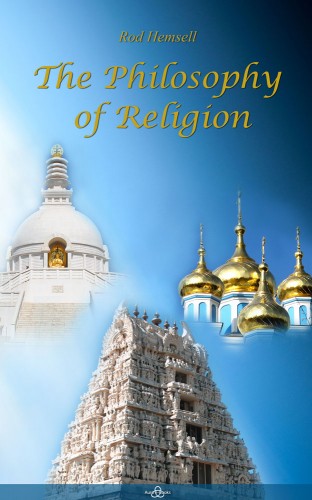
The Philosophy of Religion
The material in this book is a transcription of a series of twelve lectures presented by Rod Hemsell at Savitri Bhavan in Auroville, India. With broad brush strokes highlighted with interesting and intricate detail, Rod paints a rich historical portrait illustrating the evolution of philosophical thought and its impact on religious doctrine which extends over a twenty-four hundred year span. The underlying theme, of course, is the slow and steady evolution of human consciousness flowing along many separate streams of thought springing forth from the fount of human experience while growing in knowledge. The depth of this discourse is not at all overwhelming; however, we are no longer wading in the kiddie pool here. In these lectures, Rod has introduced a number of familiar characters and ideas and he has also introduced several others who may not be so well known, all of which invites the reader to follow up with investigations of their own. Rod’s treks along ancient pathways draw us along to discover the great, underlying similarities between the major religions of today that might otherwise go unnoticed and he convinces us that such was always inevitable since we have been dealing with universal truths all along.
Book Details
Author: Rod Hemsell
Print Length: 172 pages
Publisher: Auro e-Books
Original source: University of Human Unity
Contributors: Blindshiva, Krishna
Language: English
Book Download
Contents
- Preface
- Lecture 1. Introduction
- Lecture 2. Faith and Sacrifice (Parts 1 and 2)
- Lecture 3. Faith and Sacrifice (Part 3)
- Lecture 4. The Concept of Spirit
- Lecture 5. The Immutable Spirit
- Lecture 6. The Highest Good – Society and Morality
- Lecture 7. Doctrines of the Trinity – (1) Christianity
- Lecture 8. Doctrines of the Trinity – (2) Hinduism
- Lecture 9. Doctrines of the Trinity – (3) Buddhism
- Lecture 10. The Existence of God and the End of Time
- Afterword
Sample
The Philosophy of Religion
I would like to review the approach that we have taken in this exploration, beginning with Pannikar. He said that when we undertake a study of comparative religion or inter-religious understanding or the philosophy of religion, it becomes necessary to suspend if possible, or to bracket in the phenomenological sense, our personal beliefs. He says, “The positive aspect of that attempt lies in the fact that it distinguishes between the conceptualized beliefs of the person and their underlying existential faith.” When we bracket our beliefs, we can set aside the doctrines and the ideas but we still retain our fundamental experience….”The problem arises when we pretend to bracket not a formulation or a notion but a fundamental conviction of the person at the existential level.” We can’t really bracket what we know from experience, and pretend that we do not believe it. But if we accept the distinction between faith and belief, he says, we may be able to agree to a certain necessary bracketing of our beliefs. And then he says, “I would prefer to call for transcending them altogether.” And if we do that we are moving toward the realm of the reality, the spiritual reality itself, in which we have faith. And it is separate from the doctrines. If we transcend our belief system then it becomes possible to see the Christian Trinity for what it is, and the Buddhist Trinity for what it is, and the Hindu Trinities for what they are, because they are all representations of a spiritual reality. And what the philosophy of religion is trying to address is the reality of Spirit, the truth of Spirit. What is the spiritual reality? That is the object of the philosophy of religion, which has been extensively explored and articulated by the philosophers of religion and spiritual seers and teachers for thousands of years in each of the traditions. But the point is not to compare the traditions; it is to go beyond them and see the truth of the spiritual reality of existence itself. And that reality, as Newman says, is something that is extremely complex. It is not something that can be captured by one era of the development of a belief, or even by two thousand years of development. He says that the problem lies in discovering and understanding that the reality has been seen and articulated repeatedly, in new and even contradictory or heretical ways, for thousands of years, and yet the reality itself doesn’t change. The attempts to articulate it may sound different at different times because of changes in the thought process, or changes in society, or changes in consciousness, because it is not only doctrine that develops; it is also society and language and human consciousness that develop; and the way the reality is understood changes, but not the reality. The challenge for understanding doctrine, then, is to put it all together. He says that “…the increase and expansion of the Christian Creed and Ritual, and the variations which have attended the process in the case of individual writers and Churches are the necessary attendants on any philosophy or polity which takes possession of the intellect and heart, and has had any wide or extended dominion; that from the nature of the human mind, time is necessary for the full comprehension and perfection of great ideas; and that the highest and most wonderful truths, though communicated to the world once for all by inspired teachers, could not be comprehended all at once by the recipients, but, as being received and transmitted by minds not inspired and through media which were human, have required only the longer time and deeper thought for their full elucidation. This may be called the Theory of the Development of Doctrine.” [1]
Sri Aurobindo was quite in agreement with this point of view, and he expanded upon it in his Essays on the Gita. He also took major steps to reexamine in depth and restate the Hindu doctrines. He made perhaps the most powerful effort in the history of this tradition, in fact, to synthesize all of the developments and come up with the core doctrines in a language and way of thinking that is appropriate to our post-modern social and cultural conditions, emphasizing not only the necessity of the development of doctrines in order to find their fullest expression, but more importantly the necessity to make them understood by new generations and contexts of humanity and civilization in an accessible intellectual form.
…
Leave a Reply
Want to join the discussion?Feel free to contribute!